Home / Blogs
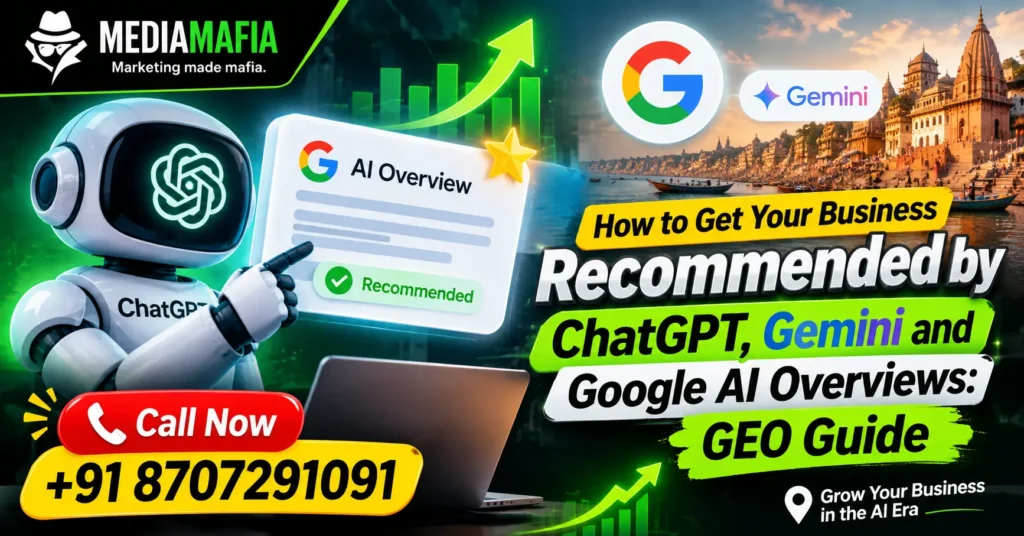
Generative engine optimization, or GEO, is the practice of making your business easy for AI tools such as ChatGPT, Gemini, Perplexity and Google AI Overviews to find, understand, trust and mention in their answers. It builds on SEO, but it rewards clarity, proof and consistency over keywords and links alone.
A few years ago a customer typed “digital marketing agency Varanasi” and scrolled ten blue links. Today the same person may ask an assistant, “Which agency in Varanasi is good for a small hotel, and what should I pay?” The assistant reads many sources, writes a single answer and names two or three businesses. If you are not one of them, the customer never even sees your website.
That can feel unfair, especially if you have spent years building your business. The good news is that AI tools do not pick winners randomly. They lean on information that is clear, consistent, well supported and easy to extract. Small, honest local businesses can compete here, because the things these systems reward are mostly things you can control: describing yourself precisely, showing real experience and being visible in more than one place.
This guide explains the whole landscape without jargon. You will learn how SEO, GEO, AEO, AIO and SXO fit together, how AI tools tend to choose sources, and the practical steps we recommend to small and mid-sized businesses in Varanasi, Lucknow, Bhadohi, Mirzapur and across Uttar Pradesh.
One honest note before we begin. Nobody outside these AI companies can promise a guaranteed mention. Anyone who does is selling certainty that does not exist. What you can do is raise your odds by being the clearest, most credible answer available. That is what the rest of this article is about.
SEO helps you rank in search results, AEO helps you become the direct answer, GEO helps AI tools cite you, AIO targets AI-generated overviews and SXO makes sure the visitor you attract actually enjoys the experience and converts. They overlap heavily, and good work in one usually helps the others.
| Term | Full form | What it aims for | Typical tactic |
| SEO | Search engine optimization | Rank pages in traditional search results | Keyword research, quality content, technical health, links |
| AEO | Answer engine optimization | Be the direct answer for a question | Question headings, short answer paragraphs, FAQs, lists |
| GEO | Generative engine optimization | Be cited or mentioned in AI-written answers | Entity clarity, original information, credible sources, mentions elsewhere |
| AIO | AI overview optimization | Appear within Google’s AI-generated summaries | Helpful content, structured data, strong page experience |
| SXO | Search experience optimization | Turn visitors into customers | Speed, clear design, trust signals, easy contact |
Here is a simple way to remember it. SEO gets you into the room. AEO and GEO get you picked when the question is asked. SXO makes the customer stay and buy.
None of these replace the fundamentals. If your website is slow, thin or confusing, no acronym will rescue it. If your content is vague, AI tools will not trust it. That is why we treat them as one connected strategy rather than separate services. If you want the underlying basics first, read our article on how SEO works in 2026.
Also note that the labels are still evolving. Different experts use them slightly differently. What matters is the practical outcome: a business that is easy to understand, easy to verify and pleasant to use.
They tend to favor sources that are clear about who they are, consistent across the web, specific in what they say and backed by evidence other people can verify. The exact systems are not public, so what follows are well-supported patterns, not guarantees.
Notice what is not on the list: keyword stuffing, hidden text, mass-produced generic articles or buying links. These approaches are not only risky in classic SEO, they also make it harder for AI systems to find a trustworthy signal. Publishing fifty thin pages rarely beats publishing five excellent ones.
Think of AI search as a careful researcher with limited time. Give it a clean, well-labeled, verifiable source and it will cite you more readily.
State plainly who you are, where you operate, what you offer and who you help, and repeat those facts the same way on every page and profile. This is the foundation of everything else.
Start with your About page. Most small business About pages are vague paragraphs about passion and values. Replace the vagueness with facts a machine and a human can both use:
Next, create a single, consistent set of profiles. Claim your Google Business Profile, a LinkedIn company page, a Facebook and Instagram page, relevant directories and any industry associations. Use the same name, description and website everywhere. Our guide to Google Business Profile optimization in Varanasi covers the local listing in depth.
Then make the connection explicit on your website with structured data. Organization or LocalBusiness markup lets you declare your name, logo, address, contact points and social profiles in a format machines read easily. The “sameAs” property is especially useful: it lists the official profiles that belong to your business, helping search and AI systems confirm they refer to the same entity.
People matter too. If a named expert writes your content, give that person an author page with credentials, experience and links to their work. Anonymous, unattributed articles look disposable. Attributed, experienced voices look trustworthy.
Finally, avoid describing yourself in superlatives you cannot prove. “Best agency in India” tells an AI system nothing. “Digital marketing agency serving Varanasi, Bhadohi, Lucknow and Mirzapur, specializing in local SEO, websites and performance advertising” tells it exactly where to place you.
Write answer-first: put a clear question in the heading, give a direct two or three sentence answer immediately underneath, then add depth, examples and proof. This is the single most useful writing habit for AEO and GEO.
Here is the pattern we use on nearly every page:
Avoid burying answers. If a user has to read through a long story to find a price range, an assistant will probably prefer a competitor who states it plainly.
Use real, original information. AI tools have access to endless generic summaries. What they cannot easily invent is your first-hand material: your own pricing ranges, your process, your photos, a local observation, a lesson from a project. Even a small fact such as “most Varanasi guesthouse enquiries arrive between 9 pm and 11 pm” is more valuable than ten paragraphs of recycled advice, as long as it is true and you can stand behind it.
Write for humans first. Short sentences, simple words and a natural voice help real readers, and those same qualities make text easier to extract. Do not write in robotic, over-optimized language. If it sounds strange when read aloud, it will probably perform poorly.
Cover the whole topic. A strong page anticipates the follow-up questions. After “what does it cost,” readers ask “what affects the price,” “how long does it take” and “what can go wrong.” Answering those inside one coherent page helps both people and machines.
Keep pages current. Add the date you last reviewed it, and genuinely review it. A page marked updated that has not changed erodes the very trust you are trying to build.
EEAT stands for experience, expertise, authoritativeness and trustworthiness, and in practice it means showing proof that real people with real knowledge stand behind your claims. Google describes it as a framework its quality reviewers use, and it is a useful checklist for AI visibility too.
Let us translate each letter into something a Varanasi business can actually do.
Experience. Show that you have done the thing. A guesthouse describes what guests commonly ask at check-in, with photos of its own rooms. A coaching institute shares anonymized batch outcomes it can verify. An agency publishes a genuine case study with the goals, steps and results, such as our digital marketing case study for PoojaPathJyotish in Varanasi. First-hand detail cannot be faked easily, and that is why it works.
Expertise. Let qualified people write or review the content. A clinic’s article should be reviewed by the doctor and credited. A legal or financial page should come from someone trained to give it. Add short bios with qualifications and years in the field.
Authoritativeness. This is how others see you. It comes from mentions, citations, reviews, local press, partnerships, speaking at events and links from reputable sites. It cannot be claimed, only earned. Start local: chambers of commerce, trade associations, college partnerships, local blogs and news outlets.
Trustworthiness. The most important of the four. It covers honest pricing, clear contact details, a physical address, secure website, visible policies, transparent refund terms, real reviews and corrections when you make mistakes. A site that hides who runs it, or promises impossible results, loses trust fast.
A practical test: if a stranger lands on your page, can they answer within thirty seconds who wrote it, why that person is qualified, how to contact the business and where they could verify it? If not, that is your to-do list.
Do not invent credentials or reviews. Besides being dishonest, they are easy to detect and can permanently damage your reputation with both search engines and customers.
Structured data, also called schema markup, labels the facts on your page so machines can read them without guessing. It improves clarity, but it does not guarantee rankings, rich results or AI citations. Treat it as good housekeeping, not a magic switch.
The types that make the most sense for a typical local or service business:
Golden rules. Markup must match what is visible on the page. Do not mark up content that users cannot see. Use JSON-LD, the format Google recommends, and test your pages with Google’s Rich Results Test and the Schema Markup Validator before publishing.
A realistic expectation. Schema helps search engines understand and connect your entities. Whether a specific AI assistant uses it directly is not something any outsider can prove. But accurate markup does no harm, reduces ambiguity and supports your other signals, so it is worth the effort when done properly.
If you use WordPress, plugins can generate most of this, but check the output manually. Duplicate or conflicting schema from multiple plugins is a common problem we find during audits.
Because AI tools rarely rely on a single page; they look for agreement across many places, so your presence beyond your own website is a major part of being recommended. Your site is what you say about yourself. Everything else is what the world says.
Here are the off-site areas that deserve attention, roughly in priority order for a local business:
Language matters in India. Many searches and conversations happen in Hindi or Hinglish. If your customers ask “Varanasi mein website banwane ka kharcha,” having a page or video that answers in the same language can open an audience your English-only competitors miss. Keep terminology natural and do not machine-translate poorly.
Be patient with reputation. Authority accumulates slowly. A business that spends a year earning genuine mentions, reviews and partnerships will outperform one that spends a week chasing shortcuts.
If you run several branches, give each location its own page and profile so that AI systems can match a question about “your Lucknow office” to the right details instead of a blurred average.
Your pages must be crawlable, fast, mobile-friendly and readable as plain text; otherwise neither search engines nor AI tools can use them, however good the writing is.
Run through this checklist or ask your developer to:
About llms.txt. You may read that you should add an llms.txt file to guide AI systems. It is a proposed convention, and as of now there is no reliable evidence that major AI products consistently use it. Adding one is harmless if you want to experiment, but do not spend your budget on it before the basics above.
How to measure progress. Track branded searches, direct traffic, enquiries and the sources customers mention. Ask new customers, “How did you find us?” and add “an AI assistant” as an option. Periodically ask ChatGPT, Gemini and Perplexity the questions your customers would ask and record whether you are mentioned, what they say and which sources they cite. Answers vary, so test the same question on different days and note patterns instead of single results.
Because AI traffic is hard to isolate, judge success by business outcomes: calls, form fills, walk-ins and sales, not only by clicks.
GEO means making your business easy for AI tools to understand, trust and mention. It combines clear writing, consistent business details, real proof and a technically healthy website.
No. SEO remains the base, because AI systems often draw on the same web content that search engines index. GEO adds extra focus on clarity, evidence and being cited inside generated answers.
There is no reliable way to buy organic mentions in AI answers. Be cautious of anyone who guarantees them. You can improve your chances through quality, consistency and reputation.
Some improvements, such as fixing business details and clarifying pages, can help within weeks. Authority from reviews, mentions and quality content usually builds over several months.
Yes. For local, specific questions, AI tools need trustworthy local information. A well-described, well-reviewed Varanasi business can be a better source than a large national site that does not mention the city.
If your customers search in Hindi or Hinglish, yes. Helpful Hindi content on key pages or videos can reach people who never search in English.
Start with your Google Business Profile and website basics: consistent name, address and phone number, a clear About page, a services page with direct answers, real reviews and a fast mobile experience.
AI search changes the screen your customers see, but not the principle behind good marketing: be clearly useful, be honest and be easy to find. Businesses that explain themselves precisely, prove their experience and keep their details consistent are the ones most likely to be recommended, by people and by machines.
If you want a team to audit your current visibility and build a practical roadmap, MediaMafia helps businesses across Varanasi, Bhadohi, Lucknow and Mirzapur with SEO, GEO, content and websites. Visit our digital marketing agency in Varanasi page or contact us to request an AI-visibility audit.