Home / Blogs
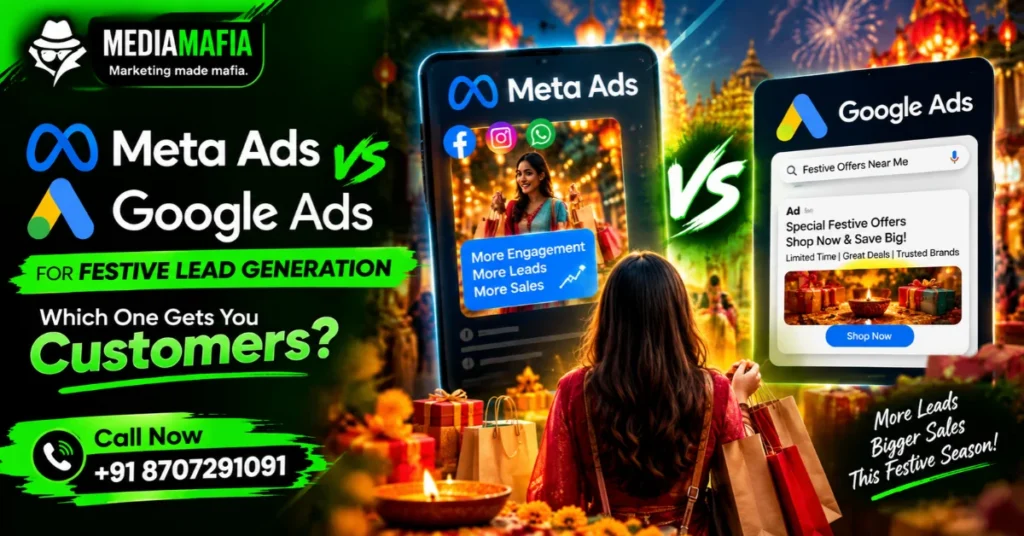
Meta ads vs Google ads is the question every small business owner asks in October, and most of the advice they hear is either too vague or too loyal to one platform. The honest answer is that the two platforms do different jobs. One creates interest in people who were not looking yet, while the other catches people who are already searching with money in hand.
We run campaigns on both for local businesses across Varanasi, Bhadohi, Mirzapur and beyond. This guide explains the difference, shows how to split a festive budget, and walks through the setup mistakes that waste the most money.
Quick answer: Use Google ads to capture people already searching for your product or service, and Meta ads to create demand and retarget visitors. For most local festive campaigns, start with a balanced split, track enquiries separately for each platform, and move budget toward whichever produces cheaper genuine leads.
Google ads respond to a stated need. Someone types “Dhanteras silver coin near me,” and your ad appears. The person has already decided to buy something, so the ad only has to prove you are the right place.
Meta ads interrupt a scroll. Someone sees a beautiful hamper on Instagram while thinking about something else. The ad has to create desire first and then give a reason to act.
Therefore, the two platforms behave differently in every way that matters: audience mindset, creative style, cost and speed.
| Factor | Google ads | Meta ads |
| Customer mindset | Searching with intent | Scrolling, not yet looking |
| Best for | Capturing existing demand | Creating demand and reminding |
| Creative importance | Text and offer clarity | Image or video quality |
| Speed to enquiry | Often fast for high-intent searches | Often needs testing and warm-up |
| Typical risk | Paying for clicks that never convert | Attracting curious scrollers, not buyers |
| Best conversion path | Landing page, call or WhatsApp | Click-to-WhatsApp, lead form or landing page |
Google ads shine when customers already know what they want. During festival season, search volume rises for gifts, jewellery, sweets, clothing, travel and services.
Use Google ads when:
Google offers several campaign types. Search campaigns show text ads for specific queries and give you the most control. Performance Max campaigns use Google’s automation across several surfaces, which can work well when you have good conversion tracking and creative assets. For a small local budget, we usually begin with Search because it keeps spending visible and focused.
Google’s own Google Ads Help explains campaign types and location targeting in detail, and it is worth reading before you spend.
Meta ads shine when you need to show something. Festive buying is emotional, and a good image or short video makes people want a product they had not thought about.
Use Meta ads when:
Meta supports click-to-WhatsApp ads, which open a chat with your business directly from the ad. For Indian local businesses, this is often the best format, because customers prefer to ask questions and see more photos on WhatsApp. Meta also offers lead forms, which collect names and phone numbers without leaving the app.
Meta’s Business Help Centre describes these formats and the rules for each.
There is no universal split, because it depends on your product and your market. Still, a structure helps you start with logic and not with guesses.
Begin with three questions.
Then build a starting plan along these lines.
| Business type | Leaning | Reason |
| Jewellery, gifting, sweets | Balanced, with strong Meta creatives | High search intent plus visual products |
| Clinics, salons, services | Google-heavy | People search “near me” when they need help |
| Fashion, decor, boutiques | Meta-heavy | Visual discovery drives purchases |
| Coaching, education | Balanced with lead forms | Parents search and also respond to offers |
| Hotels and travel | Google-heavy with Meta retargeting | Travellers search and compare |
Treat this as a hypothesis. After the first week, compare the cost per genuine enquiry on each platform, and move money toward the cheaper source.
Many owners launch ads first and ask about tracking later. That order costs real money, because platforms optimise toward whatever you measure.
Before you spend, set up the following:
Without these, you will see clicks but not customers. As a result, you cannot tell a good campaign from a bad one.
Here is a simple structure that works for most local businesses.
Keep the structure small. Too many campaigns split a small budget into pieces too thin to learn from.
We see the same errors every season.
Targeting too wide. A shop in Varanasi does not need clicks from Delhi. Keep the radius tight and exclude areas you cannot serve.
Sending traffic to the homepage. A homepage asks visitors to figure things out. A focused landing page or WhatsApp chat asks for one action. Read our festive landing page checklist for what that page needs.
Ignoring creative fatigue. Festive ads wear out fast, because people see the same image repeatedly. Plan fresh creatives each week. Our guide to festive social media creatives covers formats and hooks.
Changing too much too soon. Platforms need data to learn. Editing campaigns every few hours resets learning. Make one change at a time, and give it a few days unless something is clearly broken.
Slow replies. The best ad cannot rescue a shop that answers WhatsApp messages after three hours. Customers message several shops at once.
Judging by clicks. Cheap clicks mean nothing if nobody enquires. Judge each campaign by cost per genuine enquiry, and by sales when you can trace them.
Festival traffic creates misleading numbers. Search volume surges, social feeds fill with offers, and everyone looks successful for a week.
Compare these measures instead:
When Google produces fewer enquiries but more sales, it may beat Meta even if Meta shows a lower cost per lead. Always look at the end of the chain. We explain how to build that view in our guide to ad campaign reporting.
Paid ads work better on top of a solid base. A complete Google Business Profile, genuine reviews and a clear website make every ad rupee go further, because people check your reputation after they click.
Our local SEO guide for Varanasi businesses covers that foundation. In short, ads rent attention, while a strong profile and website help you keep it.
Neither wins every time. Google suits businesses that people actively search for, while Meta suits visual products and local discovery. Test both on a small budget and keep the one that produces cheaper genuine enquiries.
Enough to gather meaningful data, which usually means a few thousand rupees per platform over one to two weeks for a local campaign. The right amount depends on your market and your cost per enquiry.
For many Indian local businesses, yes. They move the customer straight into a conversation, which suits products where people ask questions before buying.
It can work when you have conversion tracking and strong assets. Small budgets often do better with Search campaigns first, because you can see and control where the money goes.
Search campaigns can produce enquiries within days, while Meta campaigns often need a short learning period. Start early so you have time to adjust.
The debate over Meta ads vs Google ads ends when you assign each platform its job. Use Google to catch people who are searching, use Meta to create interest and retarget, track everything and shift your budget toward what brings real enquiries.
If you would like us to plan and run both for your business, see our performance marketing services or contact us. To understand what a full package contains, read our guide to festive ads packages.