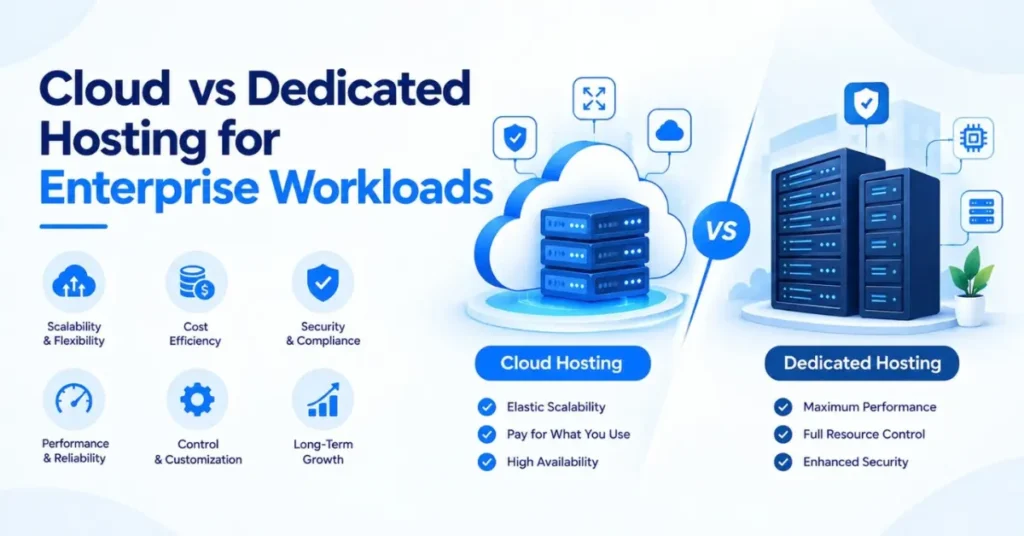
Every enterprise infrastructure decision eventually forces a direct comparison between dedicated servers vs cloud hosting, and the outcome shapes performance, cost, and long-term flexibility for years. Growing workloads, stricter compliance demands, and unpredictable traffic patterns are pushing technical teams to weigh both models carefully before committing budget and resources. Usually, the workload itself decides the answer before the spreadsheet does.
When applications are resource-intensive, enterprise-grade dedicated hosting tends to deliver steadier performance. That’s largely because of isolated hardware and resource allocation that stays consistent month to month, rather than shifting like it can in shared environments. Financial platforms, healthcare systems, and other data-intensive applications typically run better in a dedicated environment, since no neighboring tenant ever competes for the same processing power. In this blog, we’ll compare both hosting solutions in detail to see exactly when this approach outperforms cloud flexibility.
Cloud Hosting Fundamentals
Cloud infrastructure runs on virtualized resources distributed across multiple data centers, and a new instance becomes available within minutes of a request. Development teams launching a new product often start here, since there is no procurement delay and no hardware to upgrade in advance. Resource pools expand or contract with demand, which simplifies early-stage capacity planning considerably. This model also supports geographic distribution, letting enterprises place resources closer to end users across different regions.
Dedicated Hosting Fundamentals
A dedicated server belongs entirely to one enterprise. Nothing is borrowed; nothing is shared with a neighboring account. Once traffic patterns become predictable, technical teams frequently move stable, resource-heavy applications onto this kind of hardware and leave the elastic scaling behind. What’s traded away is flexibility; what’s gained is hardware that behaves identically every single day, month after month.
Performance Under Real Load
Picture a payment processor pushing through forty thousand transactions before lunch. Variance in response time isn’t an option there, and dedicated hardware removes that risk almost entirely, since no other tenant draws from the same memory or CPU pool. Throughput remains stable even under sustained pressure. Database-heavy platforms and enterprise resource planning systems tend to feel this benefit first, because a small dip in response time ripples across connected departments fast.
Handling Traffic Spikes
A retail website running a seasonal promotion, or a news outlet covering a major story, needs infrastructure that can expand on short notice. Cloud environments handle that through automated scaling: capacity increases as demand rises and scales back once traffic settles. A dedicated server handles spikes differently. It has a challenging ceiling set by the hardware itself, which is precisely why enterprises with predictable seasonal peaks plan capacity well before the busy period arrives.
Cloud Pricing Structure
Cloud billing tracks actual usage, month to month. New product launches and seasonal demand swings fit naturally here, since cost follows traffic instead of a hardware commitment made in advance. The catch surfaces later, when finance asks for a spend forecast four quarters out, and the answer is harder to pin down than it would be on a fixed contract.
Dedicated Pricing Structure
One fixed monthly fee tied to a specific hardware configuration keeps budgeting far more predictable than cloud billing typically permits. MilesWeb structures its dedicated hosting plans around this model, sizing processing power to match demanding, constant workloads without unexpected jumps on the invoice. Enterprises running steady, high-volume applications generally plan an entire financial year around this stability.
Security Control
Every firewall rule, every intrusion detection setting, and every access policy on a dedicated server answers to the enterprise alone. Cloud providers split that responsibility instead, securing the underlying infrastructure while the enterprise handles protections at the application layer. Smaller technical teams often prefer that division, mainly because it trims the daily workload of running security entirely in-house.
Hybrid Deployment Strategy
Fewer enterprises rely on one model exclusively anymore. Most teams keep core databases and anything compliance-sensitive on dedicated hardware. Everything else, including overflow traffic, testing, and customer-facing apps, runs in the cloud. This approach lets technical teams align spending with actual demand rather than over-provisioning a single environment for worst-case scenarios that seldom materialize.
Making the Decision
A full year of traffic history tells a far more honest story than the busiest month alone. Run a short trial on either platform first. Specification sheets rarely reveal what latency or support response actually feels like during an incident at three in the morning. Compliance obligations, budget structure, and workload predictability deserve more weight in this decision than brand familiarity ever should.
Concluding Insights
Neither cloud nor dedicated hosting serves as a universal solution; instead, enterprises that achieve the best results treat both as complementary tools rather than using cloud or dedicated hosting. Matching workload characteristics to the correct architecture protects performance, simplifies compliance, and keeps spending tied to real business needs instead of assumptions carried over from the last budget cycle.
MilesWeb also includes free professional email accounts and daily backups across its hosting plans, adding practical value for enterprises building a long-term infrastructure strategy. Ultimately, with the right architecture in place, technical teams gain the stability and flexibility needed to support sustained growth.